Santa Barbara Unified Takes First Steps Toward Developing AI Policy
By Andrew Sheshunoff
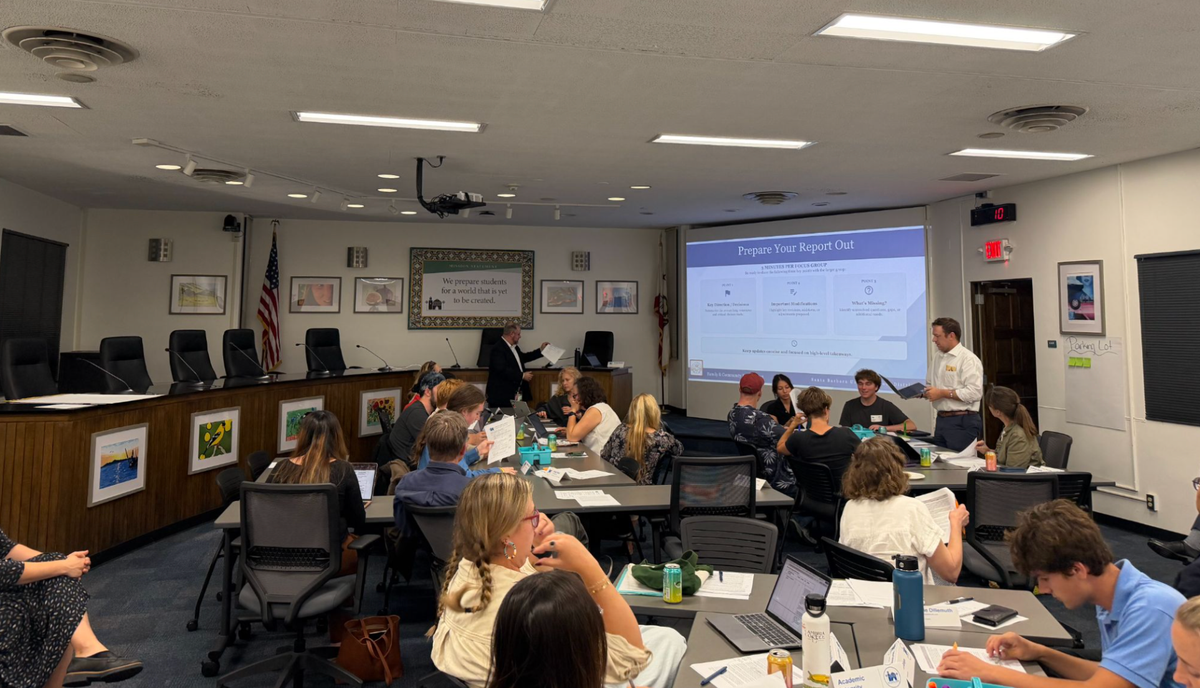
On Thursday, Sept. 24, the school board dais chairs were empty. The floor, usually lined with rows of chairs for public seating, now looked like a classroom on group project day. Desks with placards were arranged into four 8-to-10-person focus groups: board policy, academic integrity, procurement & data privacy, and professional learning plan & teacher guidelines. Parents, students, teachers, and community members found their assigned seats, greeting one another and grabbing catered Rudy’s from the table in the back. The forty or so people in the room made up Santa Barbara Unified’s AI task force, the group writing and setting new AI policies for schools and classrooms to recommend to the school board.
Robert Cooper, Director of Information Services for Santa Barbara Unified and head of the task force, explained that “the task force is for us to [do Artificial Intelligence-related] work, making decisions, building change, and getting things done. This is not a discussion group.” Cooper added that there is so much “going on in this quickly changing world of AI, but for this, we want to stay very focused… this is not about large companies. This is about our students in our community.”
This was a common thread throughout the hour and a half of deliberation and policy analysis—the AI companies seemed free of all culpability. Members felt this was not because the corporations are not to blame, but because there is simply no way to hold them to account. As a result, the policies are focused on students, school-provided devices, and teachers.
The internal task force's goals for the policy-creation process are community interest, diverse perspectives, and balanced voices, values highlighted by the members' varied demographics; students were the minority group. As written on Cooper’s slideshow, the task force aims to create policies that “protect human-centered learning, acknowledge what education problem AI is intended to address before adoption, build AI literacy, and preserve opportunities for students to learn without AI,” instead of having broader discussions around the faults and challenges with the rapidly changing AI industry.
It was the task force’s first meeting of the school year. The goal of the evening was for each focus group to read assigned sections of the California Department of Education’s model policy and determine which parts—unchanged or modified—the Santa Barbara Unified School District should include in its own AI policy. The four focus groups discussed among themselves for an hour before sharing their findings and decisions with the larger group.
The Board Policy focus group was generally concerned about the clarity of the policies, which tended to use vague and broad language outlining expectations like “AI should not substitute critical thinking,” “educators should consider ethical issues associated with AI,” and “educators should have discretion when and how AI may be used.”
The Academic Integrity focus group sought clearer rules for permitted AI use and requested fair guidelines for investigating AI misuse. For many teachers and students, the most prevalent day-to-day issues concern academic integrity and the misrepresentation of work.
The Procurement and Data Privacy table noted the necessity of privacy protections, equitable access, and a sustainable budget plan. Many artificial intelligence models charge users a set number of “tokens” per prompt: how could schools ensure that this cost wouldn’t be passed on to students, and what should the budget/token number per student be? The group’s spokesperson, who preferred to remain anonymous, also said that “part of the challenge is that the policy is going to be written in stone, but this policy needs to be reevaluated continuously.” The capabilities of premier artificial intelligence models double every three months; policy must be flexible.
Finally, the largest group, which tackled a professional learning plan and teacher guidelines, emphasized the importance of an intentional rollout of AI in classrooms. They stressed AI literacy and the need for teachers to undergo professional development and user training, and discussed the options for transparency for both students and teachers using artificial intelligence.
From the outside, it seemed like the task force was tackling AI with “cautious optimism,” with hopes of creating a well-rounded and flexible set of policies. But until official guidelines are put into place, Santa Barbara students—and students across the planet—must decide for themselves what it means to be a learner, writer, and thinker.
Cooper, who self-identified as low on the AI p(doom) scale—a percentage score that represents how likely a person believes AI will cause total global catastrophe—said that while “it [questionable AI usage] might be easier or it might be a little sneaky and fun, when it comes to growing up and being a real person with a career…they [students] all figure it out eventually.”
However, AI is not the iMac or the TI-84 calculator; it is a technology capable of independent thought (and action). Artificial intelligence doesn’t just make graphing cubic functions easier; it’s said to replace critical thinking. No policies or regulations can prevent the changes that AI will inevitably bring. This discussion is not unique to Santa Barbara Unified; it is happening in districts, in every country, in every household, and in every group chat. Many are asking similar questions: What does it mean to think critically? How do I learn how to be a functioning human in society? What does it even mean to be human?
Sources & Reporting:
California Department of Education, “Model Policy: Artificial Intelligence in Education” https://www.cde.ca.gov/ci/pl/aipolicy.asp