
“Tech with Intent” Debated in Santa Barbara Unified School District’s September Board Meeting
By Andrew Sheshunoff
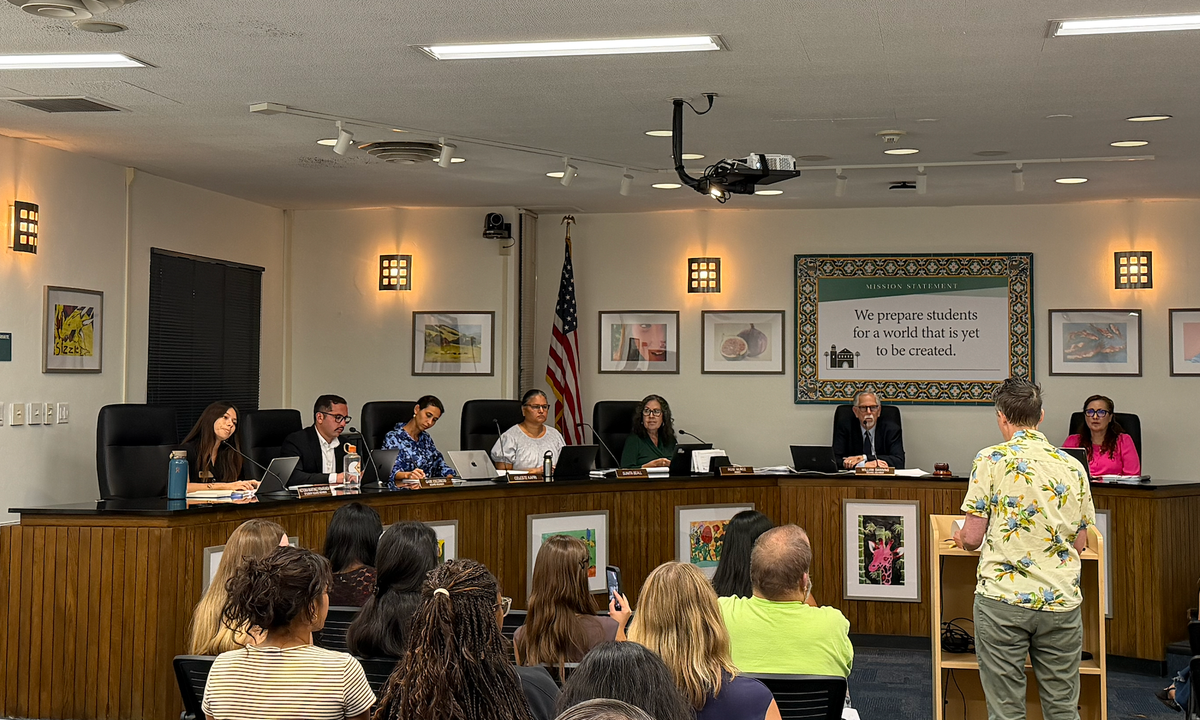
The meeting began at 6:08 p.m on Tuesday September 15th. A mosaic with SB Unified’s mission statement: “We prepare students for a world that is yet to be created,” sat inlaid in the wall behind the board members. Board President William Banning thanked the Spanish translator, then had the whole room stand for the Pledge of Allegiance.
Victoria Martinez Peñaranda, the Student Board Member—representing the students of Santa Barbara County—opened with her report. She shared common themes of student input: mental health, learning differences, and the hotly debated “Tech with Intent” policy recently enacted. “Students recognize that social media and devices pose real harm… Students with accommodations often struggle silently,” she said of the “Tech with Intent” policy.
Following Peñaranda, Santa Barbara Unified School District’s Superintendent Dr. Hilda Maldonado gave her report on school enrollment statistics. A total of 11,406 students, TK-12, are enrolled within the Santa Barbara School District system, a total enrollment drop of 1,471 students since the 2020-21 school year.
Next, the new Harding Elementary School principal, Gabriel Sandoval, and La Colina Junior High principal, Jennifer Foster, spoke separately about their experiences, current and past, in the education system.
“Tech with Intent” Public Comment
Every public meeting starts with general public comment—where any community member can speak on any issue under the purview of that board. As it started, Boardmember Banning reminded the room of California’s Ralph M. Brown Act—which prohibits the board from engaging in deep dialogue or taking immediate action on issues brought up by community members.
The public comment period was ruled by a coalition of students speaking in opposition to the recent “Tech with Intent” initiative, which involved immediate bans on YouTube and other Google Services on school issued iPads and regulation of AI platforms.
Over half a dozen students stood at the podium over the next twenty minutes, sharing survey statistics, anecdotes, and general sentiment about “Tech with Intent.”
A survey conducted by San Marcos student Mateo Gallegos and other student activists was taken by 1,700 students from Dos Pueblos High School, San Marcos High School, and Santa Barbara High School (approximately ⅓ of the total student population across the three high schools). According to the survey, 85.7% of students feel restrictions on YouTube have negatively impacted their educational experience. Another 73.2% of students said it has been far more difficult to access readings and resources, and 83.9% felt they were somewhat or not at all informed about the new tech policies. The school district is set to launch its own survey, which Superintendent Hilda Maldonado explained would be used to advise, but not decide the future of the “Tech with Intent” policies.
San Marcos student activist Autumn Richardson recounted the response of a student from San Marcos, who wrote, “As someone who has dyslexia, I heavily rely on YouTube videos for my classes that require a lot of learning. I now only have access to textbooks which take hours for me to read, and which I struggle to comprehend. The bans on YouTube and additional websites have made it harder for me to learn.”
Another San Marcos student wrote, “Since I'm taking a lot of difficult classes, I've always used YouTube as a helpful resource. Videos from math tutors, Khan Academy, and Heimler have significantly helped in high school. Without them, I'd be lost. This year has been a super difficult adjustment.”
Two teachers provided additional comments on the policy. The first commented on the difficulty of allowing access to certain educational videos, and the other shared frustration with the district and board for their failure to involve student voices in the policy’s rollout.
The primary arguments conveyed:
1) School policies cannot be based on the assumption that everyone has access to the same resources.
2) Daily tasks and homework are more challenging on iPads, often dealing with accidental website blocks.
3) Students with learning differences can be left behind by the “Tech with Intent” policy.